
What are some common terms I should know?
Language is constantly evolving, so it’s important to stay caught up on different terms and how they are used. Using the proper language and terminology is one way to show your child or youth that you understand them and their perspective. You can ask them what language they prefer to define their identity. As a parent or caregiver, taking the time to learn these concepts shows that you care for and respect your child and are choosing to use language that makes them most comfortable.
2SLGBTQIA+
This is an acronym that includes a range of sexual orientations and gender identities.
2S stands for Two-Spirit
This is a broad term coined by Elder Myra Lamaree and used by some First Nations, Métis, and Inuit peoples to refer to a person who embodies both feminine and masculine qualities and a spiritual and gender identity outside of the male-female binary.
L stands for Lesbian
This refers to a woman who has an emotional, romantic and/or physical attraction to other women. Attraction and self-identification determine a person’s sexual orientation, not their sexual experience. Some women use the term “lesbian,” and some use the term “gay.”
G stands for Gay
This describes people who have an emotional, romantic and/or physical attraction to people of the same gender (i.e., men who are attracted to people who identify as men; women who are attracted to people who identify as women). As with the term “lesbian,” attraction and self-identification determine a person’s sexual orientation, not their sexual experience.
B stands for Bisexual
This describes someone who is attracted romantically, emotionally, and/or sexually to people of the same or a different gender. This can vary over time and across situations, and someone might prefer one gender more often than another. As with the terms lesbian and gay, attraction and self-identification determine a person’s sexual orientation, not their sexual experience.
T stands for Transgender
Sometimes shortened to “trans,” this describes a person whose gender identity doesn’t align with their assigned sex at birth. A person can identify as transgender at whatever point they realize that their gender identity and assigned sex are misaligned. Not all transgender people are interested in having surgical or hormonal treatments that work to align their gender identity and sex.
Q stands for Queer or Questioning
Queer is an umbrella term used by people whose sexual orientation is not heterosexual and/or whose gender identity does not align with their assigned sex at birth. “Genderqueer” is sometimes used to describe gender, and “queer” can refer to gender and/or sexuality. The Q can also refer to a person who is “questioning” either their sexual orientation or gender identity.
I stands for Intersex
This refers to people whose bodies show characteristics that are associated with both female and male biology (hormones, chromosomes, internal or external genitalia, or any combination of primary and/or secondary sex characteristics). This can sometimes be the case from birth, or it might develop in adolescence or adulthood—and in either case, since this is about biological sex, it isn’t necessarily associated with a person’s gender identity or sexual orientation.
A stands for Asexual
Sometimes also called “ace,” this refers to a person who doesn’t experience sexual attraction. This is different from a chosen behaviour like celibacy or abstinence. Instead, it’s an orientation that doesn’t define sexual behaviours.
+
The plus sign can refer to people who identify as non-binary, pansexual, omnisexual, aromantic, polysexual, or another expression.
Gender
This is a set of socially constructed roles, behaviours or attributes that people in society think are appropriate based on a person’s assigned sex. We used to consider gender and sex to be the same, but we now recognize that a person’s gender might be different from the sex they were assigned at birth.
Gender Binary
This is the notion that there are only two genders (female and male) and that every person is one or the other, there is no blurring or mixing, and there is a clear distinction of roles. It is used to reinforce the idea of gender roles in society (e.g., the women stay home and care for the children while the men go out to work). This concept has been disproven.
Gender Identity
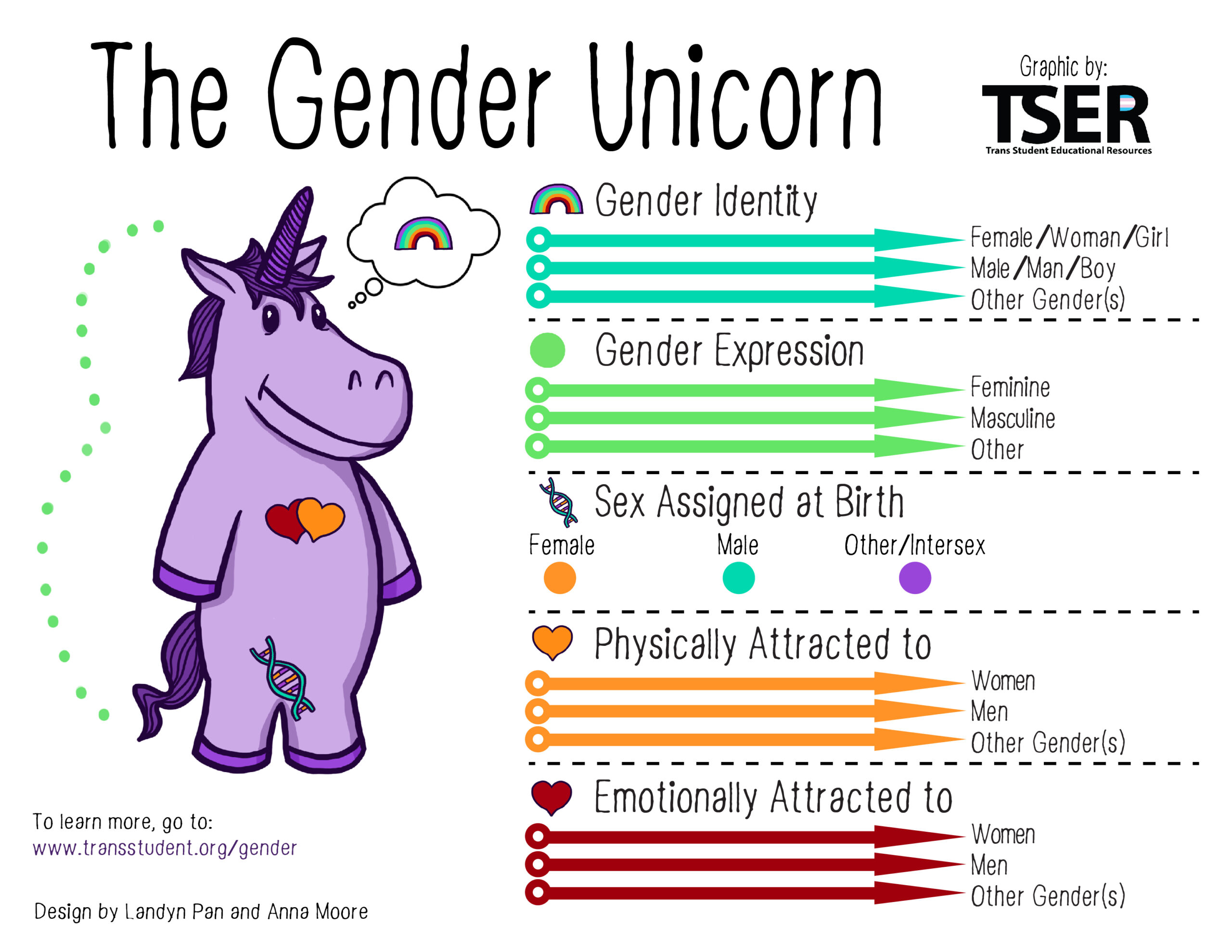
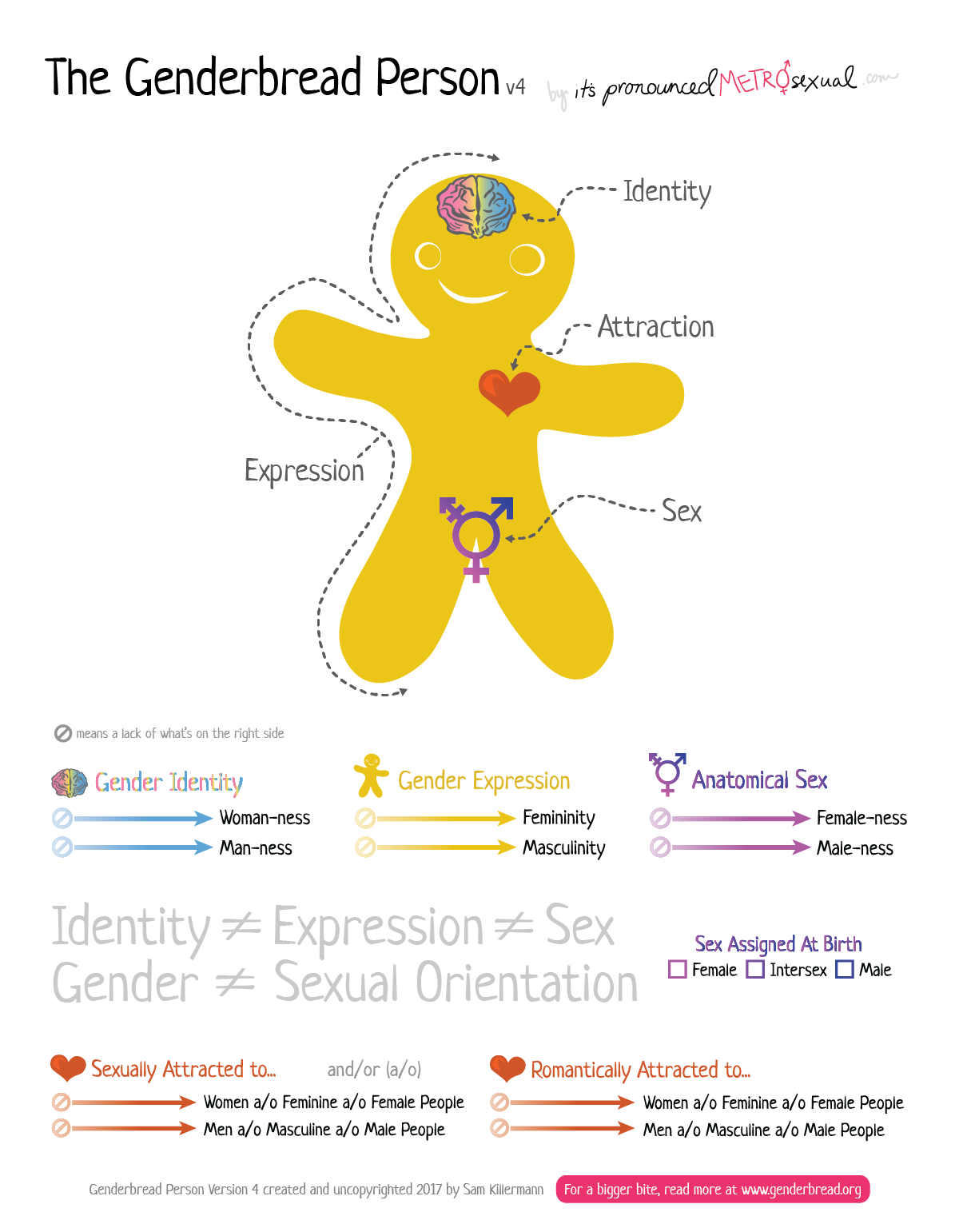
This is a person’s core sense of self as it relates to gender. It’s how we feel as an individual (which could be female, male, neither, both, or somewhere else along the spectrum of gender). Gender identity doesn’t always correspond with a person’s biological sex, can shift and change over a person’s lifetime, and isn’t necessarily visible to others.
Gender Expression
A person can present their gender identity to others through the clothes they wear, their voice and speech patterns, their body language, the way they wear their hair, and their names and pronouns. “Feminine” or “masculine” characteristics and behaviours may be different across cultures and shift with time. Gender expression (also called “gender presentation”) does not necessarily reflect a person’s sexual orientation.
Gender Diverse or Gender Non-conforming
This is a broad term for those who either don’t follow gender stereotypes or who have an expanded view of gender expression or gender identity. The way a person expresses their gender can shift and change over time.
Check out these two infographics to help get a better understanding of some of these concepts.
Non-binary
Similar to gender diverse or gender non-conforming, non-binary refers to people who don’t define their gender according to binary categories and see themselves as existing between or beyond the man-woman continuum. In addition to the term “non-binary,” people can refer to themselves as “genderqueer,” “genderfluid,” “gender non-conforming,” “gender diverse,” or “gender expansive. As with all language, it’s important to use the term that the individual you’re interacting with prefers.
Cisgender
Sometimes shortened to “cis,” this is a term used to refer to an individual whose gender identity aligns with the sex assigned to them at birth. People who are not trans should avoid calling themselves “normal” and instead refer to themselves as cisgender or cis.
Gender Dysphoria
Sometimes, a person’s assigned sex at birth doesn’t align with their gender identity, which can lead to feelings of distress. When these feelings of distress reach clinical levels, the term used is gender dysphoria.
Sexual Orientation
This is a way to describe patterns in who a person is sexually or romantically attracted to. Who a person is attracted to and how they self-identify determines their sexual orientation—a person’s sexual behaviours may not always reflect their sexual orientation. While sexual orientation and gender identity are distinct concepts, they are related—sexual orientation is related to a person’s gender and the gender of the other person. You can refer to the 2SLGBTQIA+ acronym above to learn about different sexual orientations.
Questioning
When someone is “questioning” their sexual orientation, gender identity and/or gender expression, they’re in the process of exploration. This is an important process that may happen at any age.
Heteronormativity
The assumption that heterosexuality (i.e., being “straight”) is superior to all other sexualities, is the “default” or norm, and that other sexualities are “different” or “abnormal.”
There are many more definitions that you can read more about at pflag.org/glossary.
Remember, these terms tend to shift and change over time, and people may favour one way of identifying themselves over another. Sometimes, you might have to be comfortable with not knowing and asking your child or youth what they mean by a given term. Listen to them and make space for them to not have all the answers. As a parent or caregiver, the terms you use around gender and sexuality are very important to the young people in your life, so it is incredibly meaningful when you learn these common terms and support your child or youth’s preferences.